
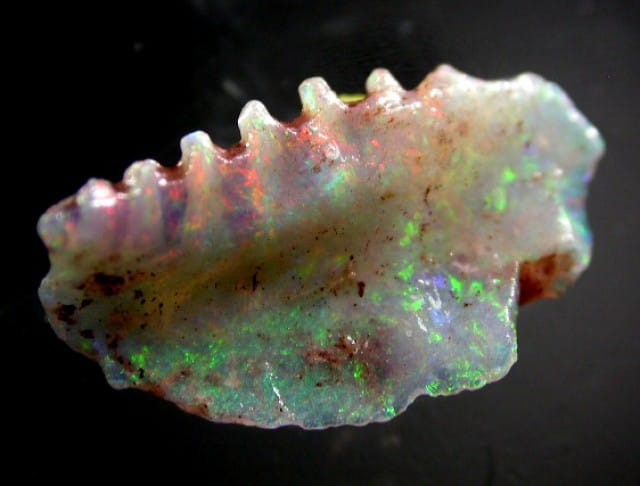
History of the opal: dinosaurs, opalization and large Australian deposits
The opal is one of the most fascinating stones in the world. With its changing reflections and sometimes spectacular colours, it has captured gem lovers, collectors and nature lovers for centuries. Yet behind its beauty, the opal hides a much older story. Its origin dates back to millions of years, when dinosaurs still lived on Earth.
In Australia, some of the doopal deposits are located in Cretaceous lands. This means that these stones are linked to prehistoric landscapes, ancient inland seas, extinct forests and sometimes even opalized fossils. The story of the opal is therefore not limited to jewellery. It also joins geology, prehistory and the fascinating world of dinosaurs.
What is the opal?
The opal is a stone composed of hydrated silica. Unlike other gems, it does not have a classic crystal structure. It is precisely this particularity that gives it its unique appearance.
Some opals present an extraordinary set of colours. Depending on how the light passes through their internal structure, they can reveal blue, green, red, orange or purple shrapnel. Each stone then becomes totally unique, with its own character, its own drawing and its own light.
It is also what makes opal so sought after. It is never quite identical to another. Each opal tells a different story, formed slowly by nature.
What's the story of opal?
The story of the opal begins long before the appearance of the human being. In some parts of the world, and particularly in Australia, this stone was formed in very ancient rocks, sometimes contemporary of the dinosaur era.
At that time, large areas of Australia were covered by shallow seas, wet plains or sediment-rich environments. Over time, geological conditions have changed. Water circulated in the basement, loaded into silica, and slowly deposited this material into cracks, cavities, and some porous areas of the rock.
Thus the opal began to form. For millions of years, nature has created stones of exceptional beauty, but also, in some cases, absolutely extraordinary opalized fossils.
How does the opal form?
The formation of the opal is a slow and complex natural phenomenon. It all starts with water rich in silica. This water infiltrates the soil and flows through the rocks. When it finds cracks, cavities or open spaces, it gradually deposits the silica it carries.
Over time, this silica accumulates, stabilizes and then hardens. It is this deposit that gives birth to the opal.
In some cases, the internal structure of silica is regular enough to produce a set of colours. In other cases, the opal remains simpler, without marked reflections. Therefore, all opals do not have the same intensity or value.
The beauty of an opal therefore depends both on its formation, its structure and the geological conditions in which it has developed.
What is operationalization?
L-opalization is the natural process by which silica dissolves in the water into opal.
This can occur in several ways. Sometimes silica simply fills a crack or cavity in the rock. At other times, it gradually replaces an older material. This is the second case where opalized fossils can be obtained.
The process is slow, discreet and remarkable. It requires time, favourable conditions and great stability in the geological environment. Without this phenomenon, there would be no doopal veins, no opalized wood, no fossils transformed into real mineral treasures.
What's the link between the opal and dinosaurs?
The link between the opals and dinosaurs comes mainly from the age of the land where some Australian deposits are found. Some of these regions date back to the Cretaceous period, when dinosaurs still lived on Earth.
In these old environments, animals, plants and marine organisms have been buried in sediment. Much later, when silica-rich groundwaters crossed these layers, they sometimes replaced the original material with opal.
The fossil then retained its shape, but its composition changed. The result is spectacular. Instead of a classic fossil, we discover an opalized fossil, sometimes brilliant, colorful and of exceptional rarity.
This relationship between the lopal and dinosaurs makes this stone even more fascinating. It becomes both a natural gem and a witness to a world that has been gone for millions of years.
Opalized fossils: rare wonders
Opalized fossils are among the most impressive discoveries in the world of opals. They can take the form of shells, pieces of fossil wood, bones or other old remains partially or completely replaced by the opal.
These specimens are rare. They are of interest to both scientists and collectors, for they bring together two worlds into one object: the precious stone and the fossil.
For those passionate about opals, these discoveries show how much this gem is linked to the deep history of the Earth. They also remind that the opal is not only beautiful. It also carries memory, transformation and mystery.
Key locations of opal in Australia
Australia is the great land of opal. It is the most famous country for this stone, and several regions have become mythical around the world.
Lightning Ridge
Lightning Ridge is probably the most famous name when it comes to black opal. This Australian region is renowned for producing some of the rarest and most sought after opals in the world.
It is also known for its opalized fossils and its strong link to the dinosaur era. For many fans, Lightning Ridge represents excellence and prestige in the world of opals.
Coober Pedy
Coober Pedy is one of the great Australian opal symbols. The city is known worldwide for its white opal and its extraordinary mining history.
In this region, desert landscapes, troglodytic dwellings and old farms give a unique atmosphere. Coober Pedy occupies an essential place in Australia's opal history.
Andamooka
Andamooka is also one of the emblematic regions. This deposit has played an important role in the international reputation of Australian opal.
Stones from Andamooka are appreciated for their character and diversity. This place is one of the essential names for anyone interested in the history of opals.
White Cliffs
White Cliffs is one of Australia's oldest mining centres. This historic site is often cited as the beginning of opal exploitation in the country.
Its importance is both geological and historical. White Cliffs is one of the places that helped build the Australian opal legend.
Winton, Quilpie and Yowah
Queensland is also home to great opal names, including Winton, Quilpie and Yowah. These regions are particularly well known for the boulder opals, opals formed in their host rock.
These stones often offer powerful natural motifs, with a remarkable contrast between the opal and the rock matrix. They bring another vision of the beauty of Australian opal.
Why is Australian opal so fascinated?
Australian opal fascinates because it combines several dimensions at once. It is beautiful, rare, natural and unpredictable. But it also tells an immense story, made of time, water, silica, ancient landscapes and slow transformations.
Some stones evoke the great Australian deserts. Others recall the ancient inland seas. Still others connect us to the world of dinosaurs through opalized fossils.
Few gems have such a rich history. This is what makes opal much more than just stone. It becomes a real fragment of the past, shaped by the Earth for millions of years.
Conclusion
The opal is a unique precious stone, but also an exceptional witness to the history of the Earth. Thanks to the de-opalization phenomenon, water-borne silica has been able to form beautiful gems in some parts of the world, particularly in Australia.
In ancient Cretaceous lands, this same process has sometimes preserved traces of the past in a rare and spectacular form: opalized fossils. This is where the opal joins the dinosaur world and takes on an even more fascinating dimension.
From Lightning Ridge to Coober Pedy, from Andamooka to Yowah, each region tells a different story about this geological adventure. The story of the opal is therefore much more than a story of stone. It is a story of time, nature, transformation and wonder.
FAQ on opal
How does the opal form?
It forms when silica-rich water infiltrates rocks and gradually deposits this silica into cracks, cavities or porous areas. Over time, this deposit hardens and becomes opal.
What is operationalization?
L-opalization is the natural process by which silica dissolves in the water into opal. It can fill a vacuum or replace an older material, such as some fossils.
Is there a link between the opal and dinosaurs?
Yes. Some Australian deposits are located in lands dating back to the dinosaur era. This is why we sometimes discover opalized fossils in these regions.
Where do we find the most famous opals in Australia?
The best known areas are Lightning Ridge, Coober Pedy, Andamooka, White Cliffs, Winton, Quilpie and Yowah.
Why are opalized fossils so rare?
They are rare because they require very special geological conditions. The source material must be replaced by silica at the right time and in an environment conducive to the formation of the opal.

