
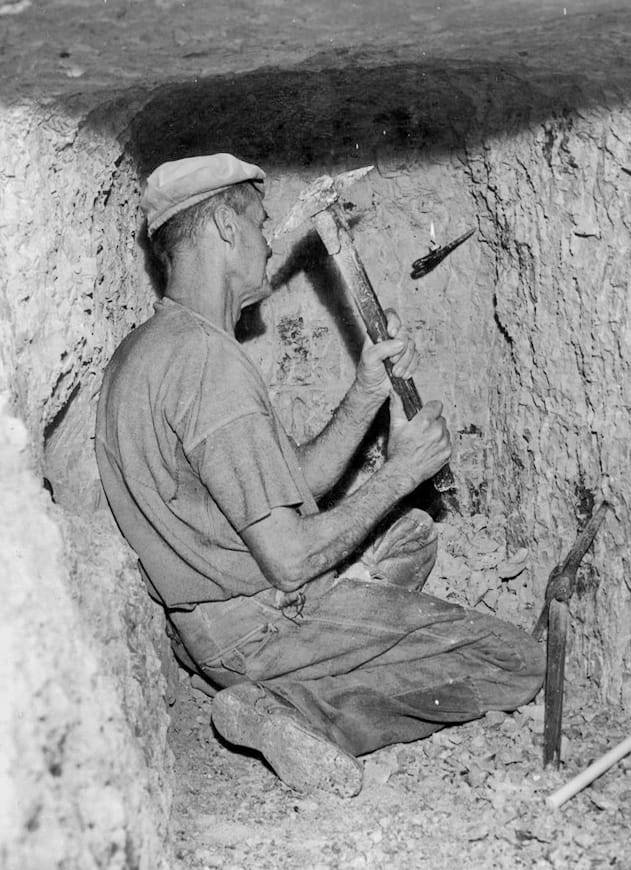
George Lowe, researcher in his mine at Lightning Ridge 1953. Source: National Library of Australia.
The history of researchers in Australia is made of adventure, patience and sometimes extraordinary discoveries. Since the end of the 19th century, prospectors have ventured into some of the most isolated areas of the Outback with the same hope: to discover under their feet an opal vein capable of changing their lives.
White Cliffs, Lightning Ridge, Coober Pedy or the immense fields of Queensland have become mythical names in the world of opal. Yet behind these stones, which are now admired in collections and jewellery, are generations of miners facing heat, lack of water, isolation and, above all, permanent uncertainty.
Because looking for an opal has a fascinating peculiarity: even after weeks of work, nothing guarantees that Gemstone is behind the next centimetres of rock.
This is the story of these pioneers of Australian opal.
Before the prospectors: a land full of history
The human history of the opal producing regions obviously does not begin with the arrival of European miners.
Aboriginal peoples have lived in these territories for thousands of years. It also occupies a place in various stories and traditions associated with Dreaming.
The commercial exploitation that appeared in the 19th century is therefore only a recent chapter in the history of these territories.
With the arrival of prospectors, however, a new era begins: that of the great discoveries that will gradually make the Australian opal known throughout the world.
White Cliffs : One of the first rushes to the opal
One of the first great episodes of this adventure takes place at White Cliffs, in western New South Wales.
It was discovered in 1889 by kangaroo hunters.
The news eventually circulates and prospectors begin to reach this isolated region. In the early 1890s, mining activity quickly became more important.
Wells are dug, concessions appear and a real mining camp develops in the midst of a particularly difficult environment.
In just a few years, White Cliffs becomes one of the first major Australian centres of production of opals.
A report by the Department of Mines of New South Wales on the year 1897 estimated the population of White Cliffs about 1,000 people, including nearly 600 minors.
The value of opal extracted in that year was estimated at 75,000 pounds, compared with 25,000 pounds in the previous year.
A real rush to the opal was born.
Extremely difficult life in Outback
The romantic image of the prospector discovering a fortune in a few picks tells only a small part of reality.
Early opal researchers worked under extremely difficult conditions.
Heat could become overwhelming. Water was rare and important cities were sometimes several hundred kilometres away.
The work was also very physical.
It was necessary to dig the wells, open galleries, raise the debris and then examine the rock in search of any clue.
And above all, nothing guaranteed the result.
A minor could work for several weeks without finding a single opal with real commercial value.
A few meters from him, another could discover an exceptional pocket.
This combination of work, experience and luck would become a fundamental feature of the lives of opal researchers.
Lightning Ridge : birth of the kingdom of the Black Opal
At the turn of the 20th century, a new region began to attract the attention of prospectors: Lightning Ridge, in the north of New South Wales.
Around 1900, Jack Murray, who worked as Boundary rider in the region, discover opal.
It is generally considered to be the first minor of opal recorded on the field of Lightning Ridge.
Discovered stones, however, have an amazing peculiarity.
Some have a very dark background with extremely intense colours.
Today, this feature seems immediately valuable.
At the time, the situation was different.
The market is more accustomed to clear and first opals Black Opals of the Lightning Ridge still have to convince buyers.
Charlie Nettleton and the commercial debut of the Black Opal
A man will play an important role in this story: Charlie Nettleton.
Nettleton was already familiar with opal exploitation as he had worked at White Cliffs.
In 1902, during a period of drought, he joined the Lightning Ridge.
It gradually understands the potential of dark opals discovered on the spot.
In 1903, Charlie Nettleton and Jack Murray went to White Cliffs with a first batch in order to try to sell their stones.
Commercial beginnings are modest, but something has just begun.
The particularly intense colours highlighted by the dark background gradually seduce traders and stonemakers.
Other prospectors then arrive on the spot.
Lightning Ridge is becoming the territory of one of the most famous opals in the world: I Australian Black Opal.
Why Black Opal of the Lightning Ridge Is she getting so wanted ?
The beauty of some opals Lightning Ridge based on a spectacular contrast.
When the body of the stone is dark, its play of colour may appear particularly intense.
Blue, green, orange, yellow and sometimes red may arise when the stone is moved under the light.
All Black Opals obviously do not have the same quality.
The value depends in particular on the intensity of the play of colour, Patterns, the Brightness, present colours, size and overall quality of the stone.
But the most beautiful specimens will help to give Lightning Ridge an international reputation.
1915: A teenager discovers opal to Coober Pedy
A few years later, another extraordinary story unfolds more than 1,500 kilometres away, in South Australia.
In January 1915, a small expedition known as New Colorado Prospecting Syndicate explore the region.
Men are mainly looking for gold.
Their research, however, does not yield the desired results and water becomes an essential concern in this desert environment.
On 1 February 1915, William Hutchison, only 15 years old and son of one of the members of the expedition, discovered some of the doopal pieces on the surface.
A few days later, on 9 February, the first concession was registered.
However, the shipping has to leave the place quickly because of the difficult conditions and lack of water.
William Hutchison, however, had just taken part in the birth of one of the world's most famous doopal fields.
The first minors of Coober Pedy
The discovery gradually attracts other researchers.
Among the first pioneers were the brothers of OsNeill and Fred Blakeley.
But working in this region poses a major problem: heat.
The summer temperatures of the Outback can be particularly high and construction materials are difficult to transport to this isolated area.
The miners will then use the rock itself to create their homes.
They're starting to build underground housing.
These houses, called Dugout, naturally offer a much more stable temperature than that of the outside.
Over time, they become one of the symbols of Coober Pedy.
Even today, part of the population lives in underground dwellings.
After World War I, new adventurers arrived
Development of Coober Pedy continues gradually.
The completion of the transcontinental railway in 1917 facilitated access to certain parts of Australia's interior.
Workers and former soldiers come to try their luck on the doopal fields.
In the following decades, the industry also attracted immigrants from many countries.
Some have mining experience.
Others fully discover the profession.
However, all share the same hope: to find enough opal to live from their work or even realize the exceptional discovery.
This diversity will profoundly mark Australia's mining communities.
How did the first doopal researchers work ?
The methods of pioneers were obviously very different from those used today.
Work was largely based on human strength and relatively simple tools.
Once a promising area had been identified, the miners drilled a well to reach the geological layer that could contain the opal.
Horizontal galleries could then be opened.
The rock had to be extracted and examined carefully.
The slightest clue was there.
A small trace of color could announce an interesting vein.
But it could also disappear a few centimetres further.
The experience of the minor thus played a considerable role.
It was necessary to learn to read the rock, understand the terrain and recognize the clues that might indicate the presence of the opal.
From Stock to Modern Machines
Over time, opal mining was mechanized.
Drilling machines, winches, excavators and various machines now allow to extract and evacuate materials much faster.
Some techniques can also be used to process large quantities of waste material in order to search for the traces of opal.
These facilities have considerably reduced part of physical work.
But they did not remove the main mystery of exploitation.
A machine allows to move more rock.
It cannot guarantee that an opal is behind the next wall.
More than a century after the pioneers, luck therefore retains an important place.
Queensland Dopal Researchers
History is not limited to White Cliffs, Lightning Ridge and Coober Pedy.
In Queensland, huge areas producing opals have their own mining tradition.
It includes the famous boulder opal.
Unlike an opal entirely separated from its mother rock, the boulder Opal is usually cut by keeping part of its natural support in irontone.
This characteristic can produce Patterns extraordinary.
The regions Yowah, Koroit, Quilpie or Winton have become emblematic of this production.
Prospectors sometimes have to travel vast distances and work in particularly isolated areas.
The pioneering spirit of the early opal researchers is still very present.
Minor, lapidary and merchant: the trip of the opal is just beginning
The discovery of an opal underground is only the first step.
Once extracted, one must determine its potential.
Some stones can be sold raw.
Others require careful work size and polishing.
For the lapidary, every decision counts.
Which orientation?
Which part keep?
Where is the best color bar?
A bad cut can significantly reduce the beauty and value of a stone.
Conversely, a perfectly adapted size can reveal a play of colour which was almost invisible in the crude.
Traders also play a key role in enabling the stones discovered in remote areas to reach international markets.
To White Cliffs, foreign buyers were already present during the great years of production of the late nineteenth century.
Thus, behind a finished opal is often hidden a whole human chain: minor, buyer, stonemaker, merchant, jeweller and finally collector.
The dream of discovering the opal that changes a life
This is probably the best explanation for the fascination exercised by this profession.
An opal researcher can dig for weeks without discovering anything unusual.
Then suddenly, a small coloured line appears in the rock.
A few extra centimetres can reveal a stone.
Sometimes a whole pocket.
This permanent uncertainty is part of Australian opal history.
Geology makes it possible to select the land.
The experience provides a better understanding of rock.
Machines allow to work faster.
But no one can know with certainty the exact place where the next great discovery is hidden.
Do the opal researchers still exist today ?
Yes.
The history of Australian opal researchers does not belong solely to the past.
Minors continue to work in several producing areas in Australia, including around Lightning Ridge and in the fields of Queensland and South Australia.
The job has changed.
Regulations are more important, equipment has evolved and geological knowledge has improved.
However, when a minor starts working a new area, the question remains the same as in pioneer times:
Is there any color behind this rock?
From the mine to the collection: why know the origin of an opal ?
For a collector or a buyer, knowing the origin of an opal allows you to better understand the stone.
Lightning Ridge is particularly famous for its Black Opals.
Coober Pedy is known for its clear and crystal clear opals.
Queensland is internationally renowned for its boulder Opals.
But origin alone is never enough to determine the quality or value of an opal.
Each stone must be examined individually according to its play of colour, its Brightness, its Patterns its state, size and natural characteristics.
However, this knowledge of provenance allows each opal to be placed in its geological and historical context.
My experience with Australian opals
Passionate about opals for many years, I had the opportunity to observe, buy and work with opals from different Australian mining fields.
Handling a Rough Opal allows us to understand how important the work done before its arrival in the hands of the lapidary is.
Some stones quickly reveal their potential. Others require much more observation before deciding how to work them.
Through Opales & GemsMy goal is also to share this knowledge of opal: its origin, its characteristics, its size, but also the history of the regions and people behind these extraordinary gems.
Conclusion: Behind each opal is a human adventure
When we see today a perfectly polished Australian opal, it is easy to forget everything that happened before it came into the hands of a collector or a jeweller.
Before becoming a gem, this opal was hidden under the Outback lands.
We had to look for her.
We had to dig.
And sometimes it was necessary to work for weeks without finding anything before finally seeing a trace of color.
Early prospectors White Cliffs to Jack Murray and Charlie Nettleton at Lightning Ridge, from young William Hutchison to Coober Pedy To the generations of minors who succeeded them, opal researchers helped build a unique Australian history.
Techniques have changed, but the dream finally remains the same:
be the first person to discover the colors of an opal that has been hidden underground for millions of years.
FAQ – Researchers in Australia
When did opal exploitation begin in Australia ?
There had already been opal discoveries before, but commercial exploitation was really gaining importance at the end of the 19th century. White Cliffs became one of the first major production centres in the 1890s.
Who discovered the opal at Lightning Ridge ?
Jack Murray is generally considered to be the first minor of opal recorded on the field of Lightning Ridge. Charlie Nettleton will then play an important role in the early commercialization of Black Opals of the region.
Who discovered the opal at Coober Pedy ?
In 1915, William Hutchison, aged 15, discovered opal while accompanying the New Colorado Prospecting Syndicate. A concession is registered a few days after this discovery.
Why? Coober Pedy Does it have underground houses ?
The extreme heat of the region caused the first miners to build houses directly underground. These dwellings, called Dugout, keep temperatures much more stable.
What is the difference between Lightning Ridge and Coober Pedy ?
Both regions produce different opals. Lightning Ridge is worldwide known for its Black Opals, while Coober Pedy is in particular deemed for its White Opals and clear.
Are we still looking for opals in Australia?
Yes. Minors and prospectors continue to search for opals in several Australian regions. Modern techniques facilitate extraction, but finding a high quality opal remains difficult and unpredictable.


