
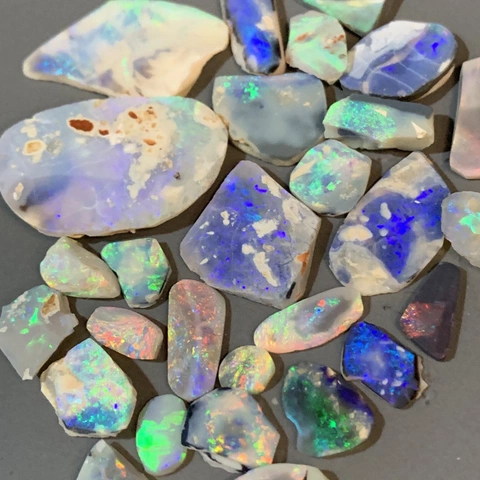
Cut one Rough Opal starts well before the first contact with a polishing disc. Before removing material, it is necessary to take the time to observe the stone, turn it from different angles and try to understand its structure.
In the opal world, we sometimes talk about « read » a Rough Opal. Of course, it is not about knowing with certainty what the stone contains. Reading an opal is more like interpreting visible clues: the presence of a color bar, its orientation, the potch, traces of sand, cracks or how the colors appear when the stone is moved under the light.
This observation is particularly important with the Australian opals, whose structure can be very different from one stone to another.
What does it mean? « read » a Rough Opal ?
Read a Rough Opal, it is trying to understand how the stone formed and especially where is the interesting part to preserve during the waist.
On some opals, the color is immediately visible. On others, it appears only on a small area or in the form of a thin line. It also happens that the potential of the stone is largely hidden by potch or rock
So the goal is not simply to look for the most colorful face.
Try to understand how this color continues inside the stone and in which direction it might be interesting to work.
It's a first estimate, never a guarantee.
Observe the opal under all its faces
One mistake would be to look only at the face that has the most color.
Before any size, it is preferable to examine all the faces of the Rough Opal On top, underside, sides and possible natural breaks.
A small colour appearance on a slice can sometimes give an indication of the continuity of a bar inside the stone. Conversely, a beautiful coloured area visible on the surface can become much thinner a few millimeters further.
It is therefore necessary to rotate the stone slowly under a suitable light and observe how the colors appear and disappear according to the angle.
Lighting and observation conditions
Before starting the size, it is important to observe the opal under good lighting. A white light allows you to better appreciate its play of colour and see how these appear when the stone is moved.
The dry stone can also be examined and slightly humidified. A wet surface can make certain areas easier to observe, especially when the crude has an irregular or dusty surface. However, it should be borne in mind that the appearance of a wet opal does not necessarily correspond to its dry appearance.
According to the Transparency or the translucency of the opal, a light source placed behind or on the side may sometimes provide additional information about its structure. However, this method is not effective on all opals, especially when they are opaque or surrounded by a significant amount of rock or potch.
On an opal already split, like an opal split, the inside of the stone is naturally much more accessible to observation. When both pieces are kept together as split pairs, their comparison may provide additional information on the continuity of structure and colour.
Identify the color bar
On many Australian opals, the desired part is presented as a color bar.
It can be relatively thick and easy to follow, but it can also be extremely thin, irregular or interrupted.
Therefore, before starting to remove material, an attempt should be made to determine:
- where the bar appears
- in which direction it seems to continue
- if its thickness appears even
- if it is close to the surface
- which is above and below.
A very colorful bar is not necessarily usable in the way one imagines at first glance. Its orientation and thickness will be of great importance in determining the shape and dimensions of the future stone.
Observe the potch, sand and rock.
The color is only part of the reading of a Rough Opal.
The surrounding material also provides a great deal of information.
The potch, i.e.Common Opal without play of colour, may surround or support the precious part of the stone. Depending on its position, it may be retained in part or gradually removed during the size.
It is also necessary to monitor the inclusions of sand and areas where the cashing material enters the opal.
A small surface trace can sometimes remain superficial. But it can also extend deeper into the stone.
This is one reason why it is often preferable to work gradually.
Search for cracks and fragile areas
Before thinking about color, you should also look at the general state of the opal.
A crack can completely alter the size project.
Suspicious lines, fractures, fragile areas and structural changes must be carefully observed. Some marks are superficial, while others may cross a significant part of the stone.
An opal that appears large enough to produce a beautiful stone may eventually have to be divided or severely reduced if a large crack appears during work.
Caution is therefore essential: maintaining weight will not be of interest if this means keeping a fragile area in the finished stone.
Follow the color and its orientation
An opal doesn't necessarily show its best play of colour In all directions.
When we turn Rough Opal Under the light, it is necessary to observe at what angle the colors become the most visible and the brightest.
This orientation can influence how the stone will be worked.
The aim is generally to present the best play of colour on the face of the future Polished Opal while retaining enough material to obtain a solid and harmonious stone.
It is a permanent balance between colour, shape, thickness and final weight.
Orientation of the future stone
Once the color bar is well identified, the tailor reflects on the orientation of the future stone. The aim is generally to present the play of colour on the main face, in the direction where it is most interesting.
This orientation will influence how the opal will be fixed to the size stick and worked on the disc on the polishing machine. It is always a matter of finding a balance between a beautiful play of colour a harmonious shape and a thickness sufficient for the stone to remain solid.
Why gradually open up Rough Opal ?
Some opals provide enough information to quickly get an idea of the direction to take.
Others require much more caution.
In this case, gradually removing the potch, sand or rock makes it possible to gradually reveal the structure of the stone.
Each new discovery area then brings new information.
The decision taken at the beginning can therefore evolve as the size changes.
It is also for this reason that it may be risky to immediately wish to give its definitive form to a Rough Opal. Sometimes it is necessary to let the stone gradually show what it actually allows to do.
Anticipate the structure of the stone
Over time, the tailor learns to get an idea of the stone's stucture before even placing it on the disc. He tries to imagine where the color bar passes, how it extends inside, where the potch, sand and cracks lie.
This first interpretation can evolve as new areas appear during the size. It is therefore preferable to gradually remove the material and regularly observe the opal, rather than seek to give it its immediate final form.
What can't be known before the waist
Even with a lot of experience, Rough Opal retains some uncertainty.
A promising bar can simmer or disappear. Inclusion may continue deeper than expected. An invisible crack at the beginning may appear. Conversely, an unspectacular area can reveal very beautiful colors after removing a few layers of material.
The visible clues therefore make better decisions, but not accurately predict the result.
This is particularly true when only a small part of the colour is visible on the crude.
Reading an opal thus remains a mixture of observation, experience and prudence.
My eyes as a lover of opals
It is precisely this uncertainty that makes the Rough Opals also interesting to me.
When I look at a stone, I do not only look for the place where the color is strongest. I'm trying to figure out how it moves, where it seems to continue and which parts of the stone will probably have to disappear to reach the interesting area.
With a Rough Opal, it is tempting to want keep maximum weight. Yet the biggest stone possible is not necessarily the best stone possible.
A few millimetres can sometimes make the whole difference between a medium opal and a stone whose play of colour is much better developed.
And despite all the observations made before the waist, there is always an unknown: what the stone will actually reveal when we start removing from the material.
It is also a great part of the pleasure of working the opal.
FAQ – Read a Rough Opal before size
Can we know exactly what a Rough Opal contains?
No. The observation allows to obtain indices on the structure, colour and any defects, but part of the opal remains hidden until the material has been removed.
What is a color bar in an opal?
This is an area of Precious Opal with a play of colour. Depending on the crude, this bar can be thick, fine, regular or irregular.
Should we always start with the most colorful face?
No. The most spectacular face does not necessarily indicate the best direction of size. It is best to observe the whole stone and try to follow the structure of the color.
Why do we sometimes leave potch under an opal?
The potch can form a natural base under the color bar. Depending on the structure of the stone, keeping part of it can preserve the thickness and strength of the opal.
A small crack in a Rough Opal Is it necessarily problematic?
It depends on its depth and position. A superficial mark may disappear during the cut, while a deep crack may require a complete change in the shape or division of the stone.
Is it possible to learn to read a Rough Opal ?
Yes, but experience plays an important role. Observing many opals before, during, and after the size allows progressively to better interpret visible indices. Even with a lot of experience, however, no reading of the crude can guarantee the result.
Must we always work a Rough Opal immediately?
No. Faced with a complex stone, taking the time to observe it again before starting the size can allow to reconsider the direction envisaged.
Can we train to read opals without cutting them yourself?
Yes. Observe Rough Opals, even splits and stones already cut, compare their appearance before and after the waist and observe the work of experienced lapidaries allow to better gradually understand the structure of an opal.

