
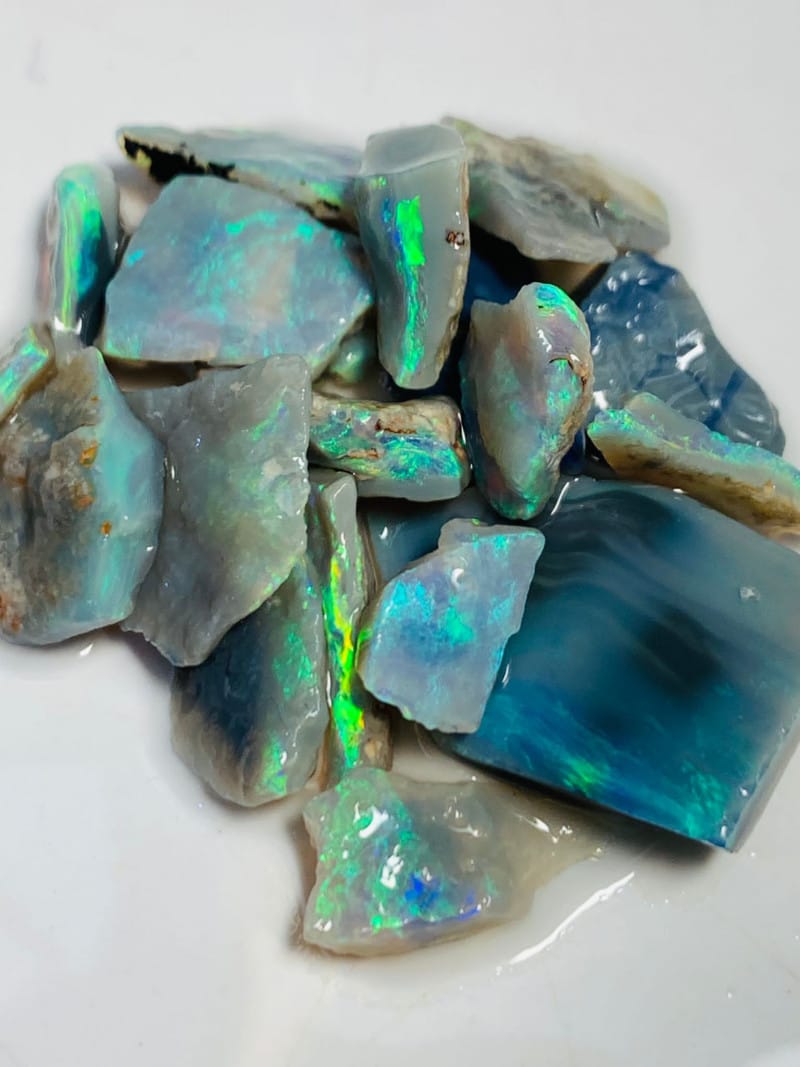
When one wants to buy a raw Australian opal, some terms may be confusing. This is particularly the case with English expressions. opal rub and nobby opal.
However, these words do not refer to two diopal varieties or two opposing categories.
First of all, nobby describes the natural shape of the stone. It is a Nodule d Rough Opal, often rounded or irregular. Minors find this training mainly in the opaliferous fields of Lightning Ridge.
However, rub described the state of preparation of the opal. A lapidary has already roughed the stone on a millstone. He removed part of the potch, sand or rock to reveal the colour.
A single piece can therefore start in the form of a raw nobby. Then, the trimming transforms it into nobby rub. Finally, the lapidary can make it a preform Then a polished cabochon.
This distinction provides a better understanding of Australian ads. In addition, it helps to measure the risks associated with sand, cracks and too thin coloured bars.
What is an opal nobby?
The English term nobby means a Nodule natural Rough Opal. Its shape is often rounded, irregular or slightly flattened.
Nobbies mainly come from Lightning RidgeIn New South Wales. The Australian region owes its reputation to its Black Opals and dark.
Unlike a vein opal, a nobby forms a more compact mass. However, a layer of potch, clay or rock may cover its surface.
Sometimes some colorful dots appear outside. In other cases, the Nodule hides almost entirely sound play of colour. Its openness therefore always retains some uncertainty.
What can a nobby contain?
A nobby does not necessarily contain a large quantity of Precious Opal. It may contain:
- of the potch1 Common Opal without play of colour
- one or more bars Precious Opal
- Of clay or sand
- of cashing rock
- inclusions and natural lines
- cracks
- of l Black Opal dark or crystal.
Thus, its external appearance is not enough to judge its inner quality.
A small coloured dot can announce a beautiful doopal bar. However, this colour can also come from a very fine layer. In this case, it may disappear during roughing.
Conversely, an unspectacular nobby can sometimes reveal a remarkable opal. That's why buying a fully closed nobby remains both exciting and risky.
Does a nobby still contain a Black Opal ?
No. Expressions nobby opal and black opal do not have the same meaning.
The first term describes the natural formation of the opal. The second indicates a black or very dark background tone.
Certainly, Lightning Ridge produces nobbies capable of revealing beautiful Black Opals. However, all Nodules do not contain a gem-grade stone.
Some hide a dark opal or crystal. Others contain mostly potch, sand or very little usable colour.
Therefore, the shape of the crude does not guarantee its colour or colour. Brightness or its final value.
What is an opal rub?
One opal rub is an opal that a lapidary has already partially deteriorated on a millstone.
During this first step, it removes part of the rock, sand or potch. He then looks for the color bar and begins to determine the best orientation.
Thus, the opal rub lies between the crude and the finished stone:
Rough Opal → trimming → rub → preform → polished cabochon
However, sellers do not always trace a precise boundary between a rub and a preform.
For example, some rubs show only a few clean faces. Others already have an oval, round or free shape. Their level of preparation may therefore vary.
Despite this first work, the opal rub is not finished. The lapidary still has to shape, sand and polish the stone before you put it on a jewel.
Why Transform a Rough Opal in rub?
The roughing helps the stonemaker better understand the stone. This includes:
- remove unnecessary parts
- search the color bar
- control its thickness
- find the best orientation
- remove part of the sand
- spot some cracks
- preparing the future form
- better observe the Brightness and Pattern.
However, this step requires a lot of caution. Poor orientation can reduce the quality of the final result.
Similarly, too much roughing can reduce the color bar. The lapidary then risks losing the best face or part of the weight exploitable.
Thus, the transformation of the crude into opal rub reveals the potential of the stone, but also its defects.
How does a nobby become a rub?
Words nobby and rub do not oppose.
On one side, nobby describes the natural formation of the opal. On the other hand, rub indicates its level of preparation.
The lapidary begins by observing the Nodule Gross. Then it gradually removes its surface in order to search for color. It also eliminates some of the potch, sand and cashing rock.
At this point, the crude nobby becomes a nobby rub.
This expression sometimes appears in Australian ads. It simply means that the stone comes from a nobby and that it has already received a first roughing.
However, an opal rub may also come from a veined opal. The word rub therefore does not specify the natural formation of origin.
What's the difference between an opal nobby and a seam opal?
To Lightning Ridge minors often distinguish between nobbies of the seam opals.
The nobby opal forms a Nodule or a compact mass. On the contrary, the seam opal occupies a crack or layer in the ground. So it often has a more flat and elongated shape.
This difference then influences the work of the lapidary.
In general, a vein opal has a rather flat color bar. Conversely, a nobby may request further observation. The tailor must understand the direction of colour while retaining enough material.
However, a nobby is not automatically more expensive than a seam opal. Several criteria determine the value:
- the Brightness
- colors
- on play of colour
- on Pattern
- background tone
- bar thickness
- defects
- final weight.
Finally, a seam opal can also become a rub after its trimming. Nobby and seam thus describe the natural formation. Rub only indicates readiness.
Is it better to buy a raw nobby or an opal rub?
The choice depends mainly on the tailor's experience, his budget and the risk he agrees to take.
Buy a completely raw nobby
A still raw nobby retains much mystery. In addition, he leaves the lapidary with complete freedom to search for color and choose his orientation.
However, this benefit is accompanied by a significant risk.
Much of the weight can come from potch, clay or sand. On the other hand, visible surface colour can disappear quickly during work.
The colour bar can also present several difficulties:
- low thickness
- sand inclusions
- an irregular shape
- wrong orientation
- a crack
- a potch line.
The weight of the raw nobby should never be compared directly with that of the future cabochon. In fact, degreasing can result in a significant loss of material.
Buy an opal rub
With an opal rub, the lapidary has already done part of the research work. Therefore, the buyer can observe colour, general shape and certain defects more easily.
It can also better estimate:
- The orientation of the future stone
- bar thickness
- the possible form
- the presence of inclusions
- yield after size.
Nevertheless, the rub retains a share of risk. Inclusion may continue below the surface. Similarly, a crack may appear during the size.
The shape of the first tailor must also be examined. It must still make it possible to obtain a harmonious cabochon.
In general, an opal rub cost carat more than a comparable crude. The seller has already devoted time to trimming and removed some of the waste. He also took the risk of opening the stone.
In return, the weight of the rub is closer to the quantity of material actually exploitable.
Which opal choose to start the size?
To begin with, an opal rub is generally easier to understand than an entirely raw nobby.
Indeed, the color bar already appears at least in part. The beginner can therefore concentrate on shaping the cabochon, sanding and polishing.
For a first size, it's best to choose:
- a stone without apparent crack
- a rather thick color bar
- a simple form
- little sand
- one colour visible from several angles
- a reasonable value.
An affordable stone allows you to learn without excessive pressure. The first mistakes are naturally part of learning.
On the other hand, a closed nobby will better suit a person who wants to learn to read and orient the crude. Its openness offers an exciting experience, but also much more unpredictable.
How to examine an opal rub before purchasing?
Only one photograph is not enough to properly judge a rub. Ideally, you have to observe the stone from several angles and ask for a video.
Check the thickness of the color bar
A spectacular surface colour does not guarantee a good final stone. First of all, the bar must retain enough thickness to allow the curved and polishing.
Too thin a layer can disappear quickly. We must therefore observe the sides of the rub, and not only its face.
Search for sand and inclusions
The sand can penetrate deeply into the opal. Thus, a small inclusion visible on the edge can continue inside.
For this reason, always consider:
- face
- back
- the sides
- contact Precious Opal And the potch.
A photograph taken only from the face does not always show these defects.
Examine cracks and natural lines
Not all lines necessarily correspond to cracks. For example, a potch line can naturally cross the stone.
However, any suspicious mark deserves verification. Ask for a close-up photograph or video taken from multiple angles.
In addition, a damp stone can mask some cracks. It is therefore also necessary to request images of dry opal.
Observe the direction of the play of colour
Some opals show their best colors in one direction. We must therefore check whether this orientation can become the face of the cabochon.
A beautiful colour visible only on the side will sometimes be difficult to preserve.
Therefore, a video remains particularly useful. It allows us to observe the Brightness when the stone moves and changes angle.
To estimate the weight actually exploitable
The weight of a rub does not match the weight of the future cabochon. Indeed, the lapidary will still remove material during shaping and polishing.
Therefore, the price per carat of a rub should not be directly compared with that of a finished opal.
Before purchasing, try to estimate the possible yield. However, no one can guarantee the result before the end of the size.
Attention to the vocabulary of ads
Sellers do not always use the same definitions. Therefore, two stones presented as rubs can show very different levels of preparation.
The first may have received a simple cleaning. Conversely, the second may already look like a preform.
In ads, several expressions may appear:
- rough rub
- rubbed opal
- nobby rub
- preform
- partially rubbed opal
- Faced rough.
Therefore, an opal should never be purchased solely from the trade title.
Before choosing, check the photographs, video, dimensions and weight. Also examine the real state of the stone and its announced origin.
Finally, a serious seller must clearly answer questions about the sand, cracks and thickness of the color bar.
My experience with Rough Opals
I've been passionate about opals for over 20 years. During this period, I observed, bought and worked many Australian stones, whether raw, rough or polished.
This experience has learned that a beautiful photograph never guarantees an excellent result after the waist.
Indeed, powerful lighting can accentuate colors. Similarly, a carefully chosen orientation may hide some weaknesses. Finally, the water sometimes temporarily intensifies the appearance of the stone.
A closed nobby can reserve a wonderful surprise. However, much uncertainty must be accepted. Looking for color can result in significant weight loss.
An opal rub is usually used to better assess the potential of the stone. However, the final result is never guaranteed. Sand, cracking or variation in thickness may still occur.
For this reason, I always examine an opal with patience and in several lights.
When buying remotely, I recommend asking:
- a net photograph of the face
- an image of the back
- precise photographs of the sides
- a video showing the moving stone
- confirmation of sand and cracks
- dry images if the seller presents the wet stone.
I am also a professional member of the International Gem Society.
Conclusion
One nobby opal form naturally a Nodule or an irregular mass. Minors mainly encounter this training in the opaliferous fields of Lightning Ridge.
The word nobby thus describes the original shape of the stone. It does not provide information on its level of preparation.
On the other hand, opal rub has already received a first grinding at the mill. The lapidary removed some of the potch, sand or rock. It can thus observe the color bar and prepare the future shape.
These two terms are therefore not opposed. A raw nobby can become a nobby rub, then a preform and finally one Polished Opal. Similarly, a seam opal can become a rub after its roughing.
For a beginner, the rub is usually easier to evaluate. Part of the color and defects already appear. However, this visibility does not eliminate all risks.
The completely closed nobby offers more mystery and freedom. However, its performance remains much more uncertain.
In both cases, caution remains essential. A spectacular photograph does not guarantee the thickness of the colour, the absence of sand, or the final result.
Before buying, look at the face, back and sides. If possible, also request a video showing the moving stone.
To better understand the natutal forms of Rough Opal, also save the difference between noby opal and seam opal.
Frequently asked questions about nobbies and opal rubs
What is the difference between a nobby and a rub?
The term nobby describes a natural formation in the form of Nodule. On the other hand, the word rub indicates that the stone has already received a first roughing.
Is an opal rub already polished?
No. The lapidary has only grossed and sometimes preformed the stone. He still has to shape it, sand it and polish it.
Do all nobbies contain a Black Opal ?
No. Some of them contain Black Opal dark or crystal. However, others contain mostly potch, sand or very little usable colour.
Can a nobby become a rub?
Yes. The lapidary turns the nobby into a rub when it starts removing unnecessary parts and revealing the color bar.
Can a seam opal become a rub?
Yes. The word rub describes the level of preparation, not natural formation. Therefore, a rub may come from a nobby or a seam opal.
Is a rub less risky than a raw nobby?
In general, a rub remains easier to examine, as it already shows some of its colour and defects. However, sand or a crack may still appear during the size.
Why does a rub often cost more per carat?
The seller has already removed some of the potch, sand and rock. In addition, he devoted time to trimming and took part of the risk associated with opening.
Which stone to choose to start?
A rub with a fairly thick bar, a simple shape and little sand is generally better suited for a beginner. It allows to learn sanding and polishing before working on a still raw nobby.


