
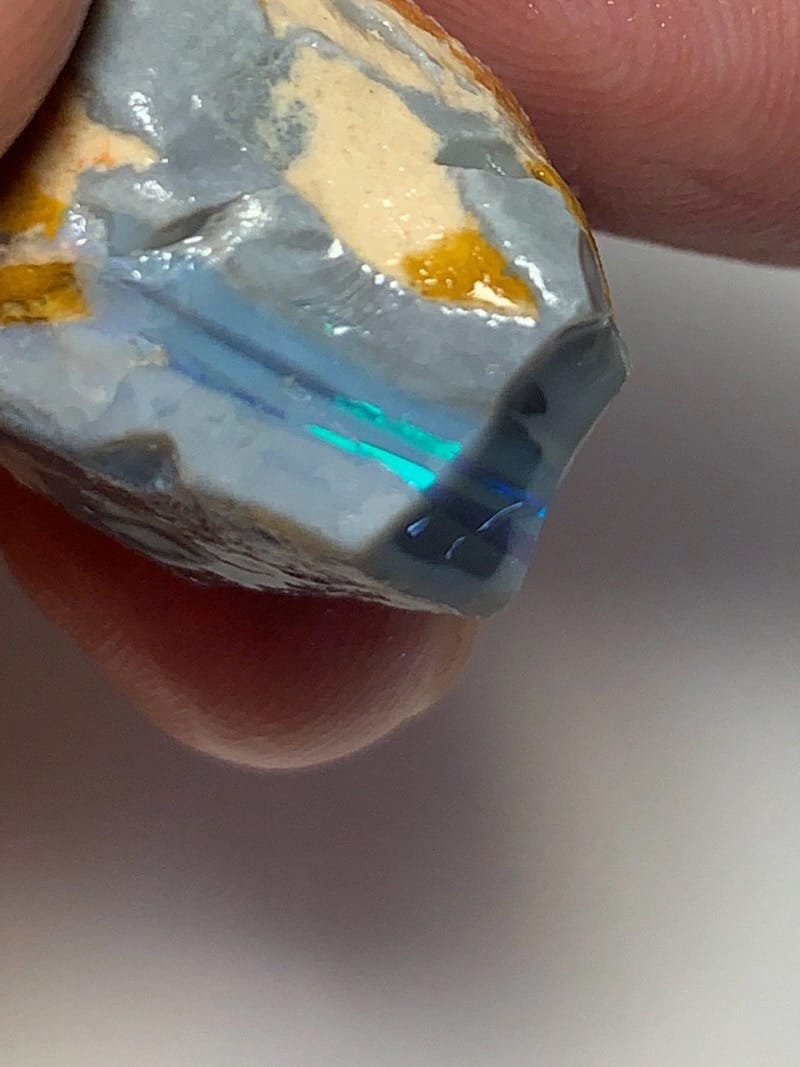
When buying a Rough Opal Its weight is one of the first information we look at. However, a 20, 50 or 100 carats stone does not allow to know how many carats d Polished Opal will actually be obtained after the size.
Between the crude and the finished stone, some of the material can disappear: sand, encasing rock, useless potch, defects, cracks or simply removed material to orientate and shape the opal.
This is what we call the size yield.
But can we estimate this performance before we start? Is there a good percentage to look for? And does a high yield necessarily mean that we got a better opal?
The answer depends primarily on the structure of the crude and the choices made during the size.
What is the yield of a Rough Opal ?
The yield corresponds to the ratio between the initial weight of the Rough Opal and the weight of the stone obtained after cutting and polishing.
Let us take a simple example.
One Rough Opal weight 20 carats before the waist. Once rough, shaped and polished, the finished stone weighs 8 carats.
The performance is then to:
8 ÷ 20 × 100 = 40 %
In this example, 40% of the initial weight is thus found in the polished stone.
This calculation is simple. On the other hand, predicting this percentage before starting to work the crude is much more difficult.
Is there an average yield for Rough Opal ?
It would be tempting to give an average percentage to estimate immediately what a Rough Opal.
In practice, that would be misleading.
Two 20-carat crudes can yield completely different results. One can contain a beautiful layer of Precious Opal relatively easy to follow, while the other can have a lot of potch, sand, rock or a very fine color bar.
Performance depends in particular on:
- natural form of crude oil
- the quantity of material exploitable
- thickness and colour position
- the presence of potch, sand or rock
- cracks and other defects
- the orientation of the play of colour
- of the shape chosen for the final stone.
There is therefore no universal percentage applicable to all Rough Opals.
Why can two opals of the same weight have different yields?
The number of carats indicates only the weight of crude oil. It does not provide direct information on the quantity of Precious Opal which can be preserved.
Let's take two crudes of the same weight.
The former has a visible colour, a relatively clean structure and little material to eliminate. The second has a beautiful coloured area, but it is surrounded by potch, sand and a crack.
Even if the two stones weigh exactly the same number of carats at first, their yield can be very different.
This is why 1o observation of a Rough Opal is essential before starting to cut it.
Weight is an important information, but it never allows it alone to judge the potential of a crude.
The amount of potch influences the yield
The potch is a Common Opal which has no play of colour.
In some Australian opals, including Lightning Ridge, I Precious Opal may be associated with a greater or lesser amount of potch.
Not all potch must be removed. A part can sometimes be preserved when it constitutes an interesting background, contributes to the contrast or is naturally part of the structure of the stone.
On the other hand, a large amount of useless potch can greatly increase the initial weight of the crude.
A relatively heavy stone can ultimately produce a Polished Opal much lighter.
Sand and rock can also reduce yield
Depending on the type of crude, part of the weight may also be sand or cashing rock.
These materials must generally be removed to achieve and properly release exploitable opal.
This is particularly important when comparing different pieces of crude: two lots with the same total weight do not necessarily contain the same amount of opal that can actually be cut.
When buying a crude carats, therefore, the number of carats must never be the only criterion for valuation.
Cracks and defects can completely change the result
A stone may look promising before size then reveal a defect during the roughing.
A crack may require the removal of a large part of the crude or even the complete modification of the original shape.
The stone must then make a choice: keep more weight with a defect, or sacrifice a few carats to get a cleaner and more stable stone.
In this case, a lower yield is not necessarily a bad result.
On the contrary, it may be the result of a decision to improve the final quality of opal.
Colour can be more important than carats
When a noble opal is cut, the goal is not simply to keep the maximum amount of matter.
We must also look for the best presentation of the play of colour.
Some opals have a directional colour. A slight change in orientation can change the appearance of the stone considerably.
The lapidary may decide to remove more material in order to obtain a brighter face, a better contrast or a more visible color.
He then voluntarily agreed to reduce the yield.
An opal of 6 carats with a superb play of colour can be much more interesting than an 8-carat stone whose color is poorly oriented.
Performance and quality should therefore not be confused.
The chosen form also influences the yield
The final shape of the opal also plays an important role.
An absolute search to obtain a perfectly regular oval can force to remove a lot of material on a crude whose natural shape does not lend itself to it.
In some cases, a free form allows better respect for the natural structure of the opal and keeps more colour and weight.
The choice depends in particular on:
- colour position
- available thickness
- any cracks
- natural form of crude oil
- future use of stone.
The best yield is therefore not necessarily achieved by imposing a standard form on all opals.
Does polishing reduce the yield much?
Grossing and formatting generally represent the main stages of material removal.
Sanding and polishing continue to remove, but in much smaller quantities.
At each grain change, the objective is to remove the marks left by the previous abrasive and gradually improve the surface state.
Too aggressive work can, however, unnecessarily remove matter. It is therefore preferable to move gradually and regularly control the stone.
Performance is thus played mainly during decisions made before and during shaping, much more than during the final stages of finishing.
Can we estimate the yield before cutting the opal?
One can try to assess the potential of a crude, but it is rarely possible to know exactly its final yield before starting.
However, the observation makes it possible to look for several indices:
- visible colour position
- apparent bar thickness
- the amount of potch
- the presence of sand or rock
- visible cracks
- the natural form of the crude
- management of the play of colour.
The more legible the crude, the more it becomes possible to imagine the stone that could come out of it.
But the opal still retains some uncertainty.
A beautiful area may disappear during the roughing, a crack may appear or, on the contrary, an unexpected colour may appear below the surface.
This is also what makes the work of the Rough Opal So particular.
Is high yield necessarily better?
No.
This is probably the most important point to remember.
A high yield of size can be interesting, but only if the quality of the stone is preserved.
Artificially keeping weight can lead to an opal that is too thick, poorly proportionate, with an unnecessary area or a less well oriented color.
Conversely, accepting greater weight loss can result in a more harmonious, brighter and finished stone.
Performance should therefore be seen as an indicator, not as the main goal of the size.
Does the return have to be taken into account when buying a Rough Opal ?
Yes, but with caution.
When you buy crude, it can be tempting to compare only the price to carat.
However, the price per carat of the crude does not correspond to the price per carat of the future polished stone.
A cheap crude containing a lot of unusable material can finally return more expensive than a more expensive crude but with a better proportion of exploitable opal.
We must therefore try to assess not only the weight, but also:
- the quantity of visible colour
- structure of crude oil
- the possible presence of defects
- the quantity of material to be removed
- the possibilities of shaping.
This estimate remains imperfect, but it allows to look at a crude other than by its simple number of carats.
My eyes as a lover of opals
That's exactly what I like about the observation and work of the Rough Opal The weight on the scale tells only a small part of the story.
With experience, I learned that it is better to observe a stone at length and work gradually rather than trying to keep each carat at any cost.
The yield is interesting to calculate, in particular to understand what has actually been obtained from a crude. But I prefer a lighter stone with a beautiful color and a balanced shape to a heavier opal, some of which have been preserved without any real interest.
Each crude is different and each stone allows you to learn something new.
Conclusion
The yield of a Rough Opal is the proportion of its weight remaining after the waist and polishing.
It can vary considerably from one stone to another depending on the potch, sand, rock, defects, colour thickness, orientation and shape chosen.
There is therefore no ideal yield or universal percentage applicable to all opals.
The aim of the lapidary is not simply to keep the maximum carats. It must seek the best compromise between yield, colour, stability, proportions and final quality.
Finally, the number of carats retained is less than what was revealed in the stone.
FAQ – Yield Rough Opal
How to calculate the yield Rough Opal ?
Just divide the weight of the Polished Opal by the initial weight of the crude, then multiply the result by 100. For example, an 8-carat stone obtained from a 20-carat crude corresponds to a 40% yield.
What is the average yield of a Rough Opal ?
There is no average yield for all opals. The result depends on the structure of the crude, the quantity of potch or rock, the defects, the position of the colour and the choices made during the size.
Does a low yield mean that the crude was bad?
No. A significant loss of material may be necessary to eliminate a defect, improve color orientation or obtain a more harmonious stone.
Can we know the yield before the size?
It can be estimated by observing the structure of the crude, but it is difficult to predict precisely. Certain characteristics or defects become visible only during the roughing.
Why a Rough Opal Does it lose so much weight?
Part of the weight may be potch, sand, rock or areas that will not be conserved. The shaping and search for the best colour orientation also results in loss of material.
Should we look for the highest possible yield?
No. A high yield is interesting only if it keeps a quality stone. It is sometimes preferable to sacrifice a few carats to improve the color, stability or proportion of the opal.
This article was written by Yannick, founder of Opalesandgems.
Passionate about opals, particularly Australians, I share my experience and knowledge to help amateurs better understand, choose and work the opal.

