
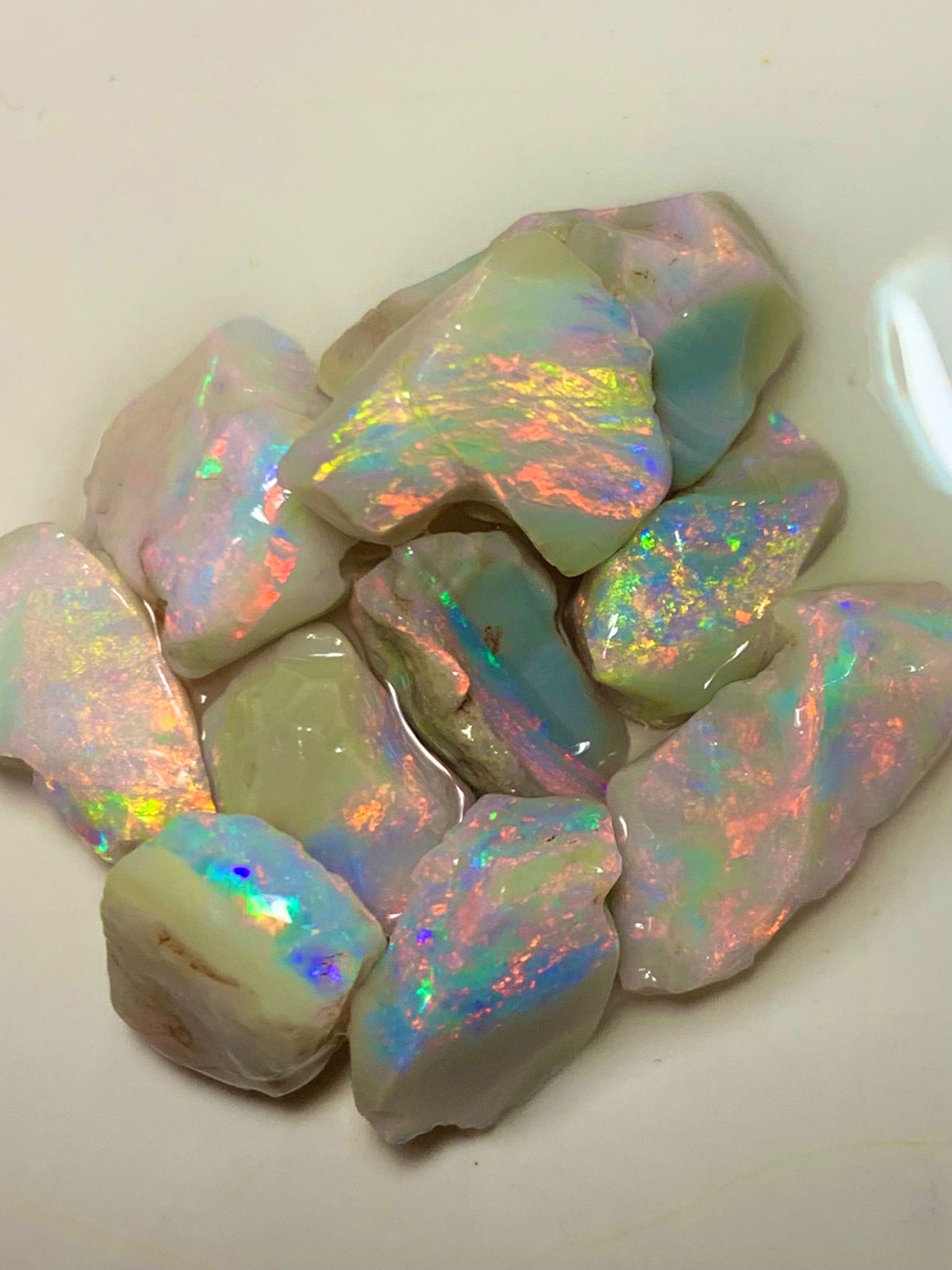
When we look at Rough Opals Australian We often see them wet on photos, in videos or directly at the sellers. This practice is common in the Australian opal world, both among miners and dealers and among lapidaries.
The reason is quite simple: a Rough Opal generally has a matte, irregular or degreasing surface. By wetting it, it becomes easier to observe its color play and certain details of the stone.
Water obviously does not transform the opal and does not create colors that do not exist. Above all, it allows us to better observe what is already present in a stone whose surface is not yet polished.
In this article, I refer specifically to the Rough Opals Australians. These observations should not be generalized to all opals, including Ethiopian opals, some of which may be hydrophanes and react differently to water contact.
Why a Rough Opal Does Australian look more beautiful when wet ?
One Rough Opal does not reflect light as a perfectly polished opal.
Its surface can be rough, dusty, covered with traces of sawing or simply matt. The light is then diffused by all these small irregularities, which can make the color game less obvious to observe.
When wet, water temporarily forms a thin film on its surface. Visually, it appears more regular and colors often become easier to distinguish.
This is particularly interesting on an opal that has already been slightly gross and whose color bar begins to appear.
The opal may then appear more vivid when wet, but water does not add any color to stone. It simply improves the conditions under which we observe.
Why wet a Rough Opal Australian before you buy it ?
When buying a Rough Opal, we buy first of all a potential.
Contrairement à une opale déjà taillée et polie, une partie de la pierre reste encore à découvrir. La couleur peut être visible en surface, apparaître sur un côté ou former une barre plus ou moins profonde dans la pierre brute.
Moistening the opal helps to observe these areas of color and better understand what the stone might contain.
This makes it possible to better distinguish:
- the visible color game
- certain colour bars
- areas already grossed up
- the potch
- how the color reacts when the stone is oriented under the light.
This is one of the reasons why Rough Opals Australians are very often presented wet when they are offered for sale.
A practice I have observed in Australia and in gem shows
I was able to observe this practice directly in Australia, at minors and dealers Rough Opals Australian, but also during the Gem shows in Bangkok and Hong Kong.
The sellers commonly wet the Rough Opals so that buyers can better observe their color play and the visible potential of stones.
This way of presenting Rough Opal is therefore not specific to Internet sales. I found it as well in the field in Australia only at international gem fairs in Asia.
Why also observe Rough Opal Dry ?
Dry observation remains complementary.
A dry opal makes it possible to observe directly its surface, its potch, its matrix possible and the various traces left by its extraction or trimming.
Moisturized, it often allows you to better appreciate her color play.
The two observations therefore provide different and additional information.
Personally, when observing a Rough Opal Australian, I like to watch her dry, wet and from several angles. It is often by turning the stone under the light that one really begins to understand how the color appears.
Why do the lapidaries use water during their waist ?
Water is not only used to observe opals before purchase. It also accompanies a large part of the work of the lapidary.
During sawing, roughing and polishing, water helps to limit heating and remove residues produced by abrasion. It also helps to maintain good visibility on the area worked.
As matter is removed, the lapidary can monitor:
- position of the color bar
- The evolution of the color game
- potch thickness
- inclusions or imperfections that appear
- the direction to be given to the future stone
- the quantity of material that can still be removed.
With the opal, a few millimeters can sometimes completely change the reading of a stone.
C’est pourquoi le travail se fait progressivement, en observant constamment ce que révèle la pierre brute.
One Rough Opal Does it show the result after polishing ?
No, and it's just one of the difficulties when you're working on a Rough Opal.
Wetting the stone gives a better reading of what is visible at this moment, but this does not allow you to know exactly what is more deeply.
A beautiful color bar can become thinner during trimming. Its orientation may change. An inclusion or potch area may appear.
Conversely, a fairly discreet stone at the beginning can sometimes reveal a much more interesting area once worked.
Water therefore helps read opal, but it does not make it possible to predict with certainty the final result.
It is precisely this part of uncertainty which makes all the interest of the work Rough Opal.
Opale australienne et opale hydrophane : ne pas généraliser.
The explanations given in this article concern: on Rough Opals Australian.
Do not automatically apply the same practices to all opals.
Some opals, including opals from Ethiopia, may be hydrophanes. They are able to absorb water, which may temporarily change their Transparency and their appearance.
This phenomenon is different from the fine water film used on a Rough Opal Australian to facilitate observation of its surface and color play.
The source and characteristics of the opal must therefore always be taken into account.
Mon regard de passionné d’opales.
After more than twenty years to buy and observe opals, including Rough Opals AustralianI used to look at a stone from several angles, dry as wet.
Lors de mes voyages en Australie, j’ai eu l’occasion d’acheter et d’observer des opales directement auprès de mineurs et de revendeurs. J’y ai retrouvé cette pratique très simple : mouiller l’opale brute pour mieux faire apparaître son jeu-de-couleurs et faciliter la lecture de la pierre.
I also observed this way of doing things during the gem shows in Bangkok and Hong Kong, where vendors presented their Rough Opals Australian buyers wet.
These experiences enabled us to observe this practice in very different contexts: on the ground in Australia as at international gem fairs in Asia.
With a Rough Opal Australian, I think water is particularly useful because it sometimes helps to better understand a stone whose surface does not immediately reveal all its color play.
Mais c’est justement ce que j’aime dans l’opale brute: you never fully know what you're going to discover before you start working the stone.
A color bar, a change of orientation or a few millimeters of potch can completely change the size project.
It is this progressive reading of the stone which, in my view, makes a large part of the interest of the Rough Opals Australians.
FAQ sur les opales brutes australiennes mouillées.
Why do we wet them ? Rough Opals Australians ?
The water visually attenuates the matt or irregular appearance of the surface and allows to better observe the color play of a Rough Opal which is not yet polite.
Does water really make an Australian opal more colorful ?
No. Water does not create new colors. It makes it possible to better distinguish the color game already present in the stone by facilitating its observation.
Why do sellers present Rough Opals Australian wet ?
This practice allows buyers to better observe the color play and the visible potential of a stone whose surface is not yet polished. This is a practice that I personally observed in Australia, but also at gem shows in Bangkok and Hong Kong.
Why also watch a Rough Opal Dry Australian ?
Dry and wet observations are complementary. The surface, the potch and the matrix possible. Moisturized, color play can be easier to distinguish.
Can we wet an Ethiopian opal in the same way ?
We must not generalize. Some Ethiopian opals are hydrophanous and can absorb water, which may temporarily change their appearance. This article specifically concerns Rough Opals Australians.
One Rough Opal Does wet Australian show the final result after polishing ?
No. It makes it possible to better observe the visible potential of the stone, but trimming and size can reveal potch, inclusions or changes in the color bar.
About the author
Yannick – Founder of OpalesandGems
Passionate about opals, especially Australians, I share on Opalesand Gems my experience and knowledge to help amateurs better understand, choose and work the opal.

